 how-to
How to Find Tailored Travel for Solo Travellers
Table of Contents
- Start with Your Travel Personality, Not a Destination List
- How to Plan a Slow-Paced Solo Trip That Actually Feels Restful
- Itinerary Planning for Solo Travellers: Build Days Around Energy, Not Ticking Boxes
- Choosing Luxury Solo Travel Accommodation Without Overpaying for the Wrong Things
- How to Find Tailored Travel Experiences Through Local Knowledge, Not Booking Sites
- Safety, Logistics and Budget Management for Independent Solo Travel
- Solo-Friendly Ways to Meet People Without Forcing Social Connection
- Conclusion
- Frequently Asked Questions
Last Updated: September 22, 2026
Start with Your Travel Personality, Not a Destination List
The best starting point for how to find tailored travel experiences for solo travelers is your own travel personality, not a list of places.
The Introvert's Itinerary vs the Explorer's Route
An introvert's ideal day has long, quiet stretches. One landmark, a slow lunch, and time to read by a loch. An explorer wants movement: three stops before noon and a new trail by mid-afternoon.
Ask yourself two questions before you research anything:
- Do I feel recharged by people, or by quiet?
- Do I want a full schedule, or open space to decide as I go?
Your answers shape every choice that follows.
How to Plan a Slow-Paced Solo Trip That Actually Feels Restful
A slow-paced solo trip works when you plan fewer stops and add buffer time to every leg of the journey. Most visitors try to see everything in a day or two. That approach misses the island's quieter corners entirely.
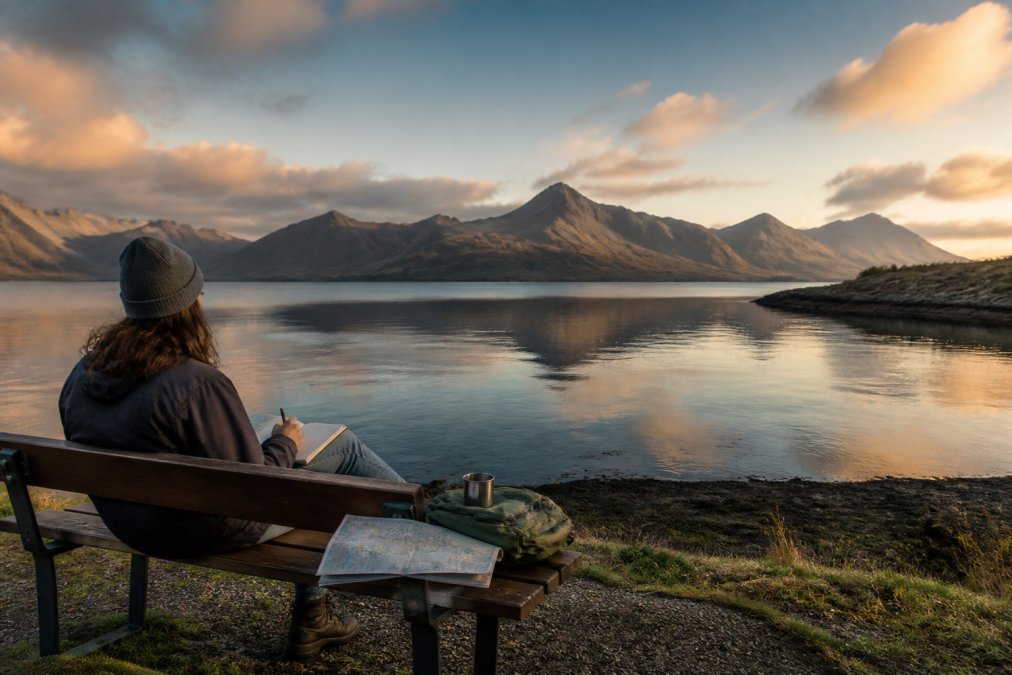
Travel confidence grows when you stop rushing.
The 20-Minute Rule for Highland Roads
Add 20 minutes to every hour of travel on highland roads. A drive that looks like 60 minutes on a map is really 80.
Itinerary Planning for Solo Travellers: Build Days Around Energy, Not Ticking Boxes
Good itinerary planning for solo travellers starts with energy, not attractions. Group your biggest activities into your strongest hours and protect your low-energy windows.
A practical structure looks like this:
- Pick one anchor activity per day, such as a castle visit or a coastal walk.
- Add one optional extra you can drop without regret.
- Leave the evening free for a slow meal.
- Keep one full day completely unplanned.
Choosing Luxury Solo Travel Accommodation Without Overpaying for the Wrong Things
Luxury solo travel accommodation is worth the money when it buys you sleep quality, space, and genuine local knowledge. It is not worth it when you are paying for chandeliers and a lobby you never sit in.
| What You Pay For | Worth It? | Why |
|---|---|---|
| Quality bed and quiet room | Yes | Sleep decides your whole trip |
| Real space to unpack | Yes | Cramped rooms wear you down |
| Hosts who know the area | Yes | Saves hours of guesswork |
| Grand public areas | Rarely | You are out exploring |
| Extras you won't use | No | Adds cost, not value |
What Bespoke Hospitality Should Actually Include
Genuine bespoke hospitality shows up in small, specific things. A host who books your restaurant before you arrive. A room with a handmade bed and an ensuite. A breakfast made from local ingredients, not a buffet tray.
How to Find Tailored Travel Experiences Through Local Knowledge, Not Booking Sites
Tailored travel is built from local knowledge, not search filters. Booking sites sell the same ten tours to everyone. A host who lives on the island knows which craft studio is open on a Tuesday and which beach is empty at sunset.
Here is how to find the good stuff:
- Ask your accommodation for a personal plan, not a brochure.
- Look for local artisan trails and craft routes that big operators skip.
- Book restaurants in advance, because the best tables go early.
- Use VisitScotland's official trip planning resources for verified opening times and travel updates.
- Check the Royal Society for the Prevention of Accidents' countryside safety guidance before walking remote routes.
Safety, Logistics and Budget Management for Independent Solo Travel
Independent travel runs smoothly when you handle three things early: safety, logistics, and budget management. Get these right and the rest of the trip takes care of itself. The trick is to treat them as one system rather than three separate chores, because a logistics failure (a missed ferry, a dead phone) usually becomes a budget problem, and a budget problem usually pushes you into a safety compromise.
- Accommodation: usually the biggest single cost, so book it first and lock the rate
- Food and dining: allow more than you think if good local restaurants are part of the point of the trip
- Transport: fuel, ferries, parking and tolls add up quickly on island and rural routes
- Activities: guided walks, workshops and entry fees, which are easy to forget when planning
- Buffer: keep a genuine reserve for weather changes, missed connections and spontaneous extras
Travel Insurance and Safety Precautions That Actually Matter
Travel insurance matters most for the things you cannot plan: cancellations, medical costs, and lost luggage. Read the policy before you buy it, not after something goes wrong. Check the excess on each type of claim, because a low premium with a high excess can cost more than a higher premium if you actually claim. Confirm whether the policy covers the activities you plan to do, walking and sightseeing are usually standard, but anything more adventurous may need extra cover or a specialist policy.
For safety precautions, keep it simple and repeatable:
- Share your daily plan with someone at home, including an expected check-in time.
- Carry water, a charged phone, a power bank and a paper map.
- Download offline maps before you leave signal range, because coverage drops on remote roads.
- Check the Met Office weather warnings before any long drive or walk.
- Tell your accommodation where you are going and when you expect to return.
- Keep a small amount of cash for places that do not take card.
The Psychological Side of Travelling Alone
Most guides stop at logistics. The part they miss is the mental preparation, and it is the part that decides whether a solo trip feels freeing or frightening. A useful framework is to plan for three predictable moments:
- The arrival dip. The first evening alone in an unfamiliar place often feels flat. Pre-book one small, low-effort thing for that evening, a table, a short walk, a bath, so you are not deciding anything while tired.
- The mid-trip wobble. Around day three or four, the novelty fades and loneliness can surface. Build in one social anchor for that day: a guided walk, a class, or a meal at a shared table.
- The decision fatigue. Solo travel means making every choice yourself. Cap it by deciding the next day's anchor activity the night before, and leaving the rest open.
Solo-Friendly Ways to Meet People Without Forcing Social Connection
Social connection on a solo trip happens best through shared activity, not forced mingling. A guided walk, a craft workshop, or a cooking class gives you a natural reason to talk to people. The mistake most solo travellers make is treating socialising as a task to complete rather than a by-product of doing something they already enjoy.
Match the Method to Your Personality, Not the Other Way Around
Most advice on meeting people assumes everyone wants the same thing. They do not. Tailoring your social strategy to your own temperament is the single most useful adjustment a solo traveller can make, and it is the part almost every guide skips.
- If you recharge in quiet: choose parallel-activity settings where conversation is optional, a guided walk, a life-drawing class, a long table at a quiet café. You get proximity to people without the pressure to perform.
- If you recharge around people: choose structured, time-boxed social settings, a cooking class, a pub quiz, a group hike with a fixed end point. The structure gives you permission to talk and a natural exit when you are done.
- If you are somewhere in between: use the "one social anchor per day" rule. Book a single activity that involves other people, then let the rest of the day be yours. This prevents both isolation and exhaustion.
Other low-pressure options that work across personality types:
- Sit at a shared table at a local pub, where conversation is normal but not required.
- Join a short local tour with a guide who lives nearby and can introduce you to people.
- Take a class in a traditional craft, where the activity gives you something to talk about.
- Chat with your hosts, who often know everyone worth knowing and can make introductions.
Conclusion
Building a trip around your own energy, not a checklist, is the hardest part of travelling alone. Most people book the trip everyone else books, then wonder why they come home tired.
Frequently Asked Questions
How can solo travellers find unique, non-touristy experiences?
Skip the generic booking sites and ask your accommodation host directly. Local owners know which craft workshops, quiet coastal walks and family-run restaurants never make it onto the big platforms. On the Isle of Skye, for example, touring the studios of local artisans through a printed booklet gives you access to makers and trades you would never find through an algorithm. Build your itinerary around two or three of these off-the-beaten-path stops per day rather than chasing famous landmarks.
What should I look for when choosing a boutique lodge for a solo stay?
Look for three things: genuine local knowledge, room dimensions stated honestly, and a host who will help with itinerary planning before you arrive. Ask whether they can book restaurants on your behalf, since popular Highland venues fill up weeks ahead. Read reviews that mention personal service, not just decor.
Is it better to book a solo tour or plan a bespoke itinerary?
It depends on your travel confidence. Escorted tours and small group adventures handle logistics and give you built-in company, which suits first-time solo travellers. A bespoke itinerary gives you flexibility, downtime and the freedom to follow your own pace. Many people combine the two: join a small group for one element, such as a guided hike, then travel independently for the rest. If you want cultural immersion and quiet, independent travel with a well-chosen base usually works better.
How do I ensure safety while travelling solo in remote areas?
Share your daily route with your accommodation host and check in when you return. Carry a paper map as well as a phone, since Highland signal can drop without warning, and add 20 minutes to every hour of estimated driving time on single-track roads. Take out travel insurance that covers the activities you plan, including walking or island hopping. Book accommodation with a host on site rather than a self-check-in property, so someone knows your plans and can raise the alarm if needed.