 How-to
How to Pack Fragile Artisan Ceramics for Travel
Table of Contents
- Deciding Whether Your Ceramics Travel in Hand Luggage or the Hold
- Gathering the Right Protective Materials
- How to Wrap Ceramics for Travel, Piece by Piece
- Packing Ceramic Plates and Flat Pieces Safely
- Packing Pottery in a Suitcase Without Movement
- Unpacking and Checking Your Pieces at Your Destination
- Booking Your Stay and Planning Your Next Steps on Skye
- Frequently Asked Questions
Last Updated: October 29, 2026
Knowing how to pack fragile artisan ceramics for travel is less about luck and more about method. At Skye Lodge, we have welcomed many guests who have arrived on the Isle of Skye with a treasured piece of pottery in their luggage, and the ones who arrive intact share a few habits. This guide walks you through deciding where your pieces should travel, gathering the right materials, wrapping each piece properly, and unpacking safely once you arrive.
Deciding Whether Your Ceramics Travel in Hand Luggage or the Hold
The first decision shapes everything else. Hand luggage stays in your sight and under your control, which makes it the safer choice for your most valuable or delicate pieces.
The practical travel question is not just which bag, but which piece goes in which bag, and how to get it through security without a struggle.
Check the rules before you pack
Airline cabin baggage rules vary by carrier and by fare. Security rules also change, so verify the current guidance from your airport on what may be carried in cabin baggage (Hand luggage restrictions at UK airports: Liquids).
A useful habit is to weigh your packed cabin bag at home on bathroom scales. A single stoneware vase can add a surprising amount, and cabin bag weight limits are often stricter than travellers expect.
Decide piece by piece
Use this as a starting point, then adjust for your airline and your own tolerance for risk:
- Cabin bag: Small, high-value or irreplaceable pieces such as a single mug, a small bowl, a bud vase or a lidded pot that fits in a padded case. These are the pieces you would most regret losing.
- Checked bag: Larger, heavier or replaceable pieces, plates and sets that you can fully surround with clothing and cushioning. Checked bags can absorb more volume, but they also take far more handling.
- Split the load: Never put a whole set in one bag. If one bag is lost, delayed or damaged, you still have part of the set.
Getting through security without damage
Security screening is a handling step in its own right. Trays are lifted, stacked and pushed, and a loosely wrapped piece can shift. Keep each ceramic in its own padded case or snug box inside your cabin bag so it does not roll around when the bag is opened. Allow extra time at security so you are not rushed.
When the hold is the right choice
Some pieces simply should not fly in the cabin: large platters, heavy stoneware sets, or anything that would take your cabin bag over its weight limit. If a piece goes in the hold, treat the hold as the rougher journey it is. Use a sturdy outer box, double-box where you can, and surround the inner box with clothing so the piece never touches the suitcase wall.
Gathering the Right Protective Materials
Good packing starts with the right supplies. Gather these before you touch a single piece:
- Bubble wrap in two thicknesses, a thin layer for wrapping and a thicker layer for cushioning
- Acid-free tissue paper for a soft first layer that will not stain glazes
- Sturdy cardboard boxes, one slightly larger than each piece
Reusing your own clothing and towels cuts waste and gives you soft filling that doubles as protection. Keep what you collect in one place so nothing gets missed on the day.
How to Wrap Ceramics for Travel, Piece by Piece
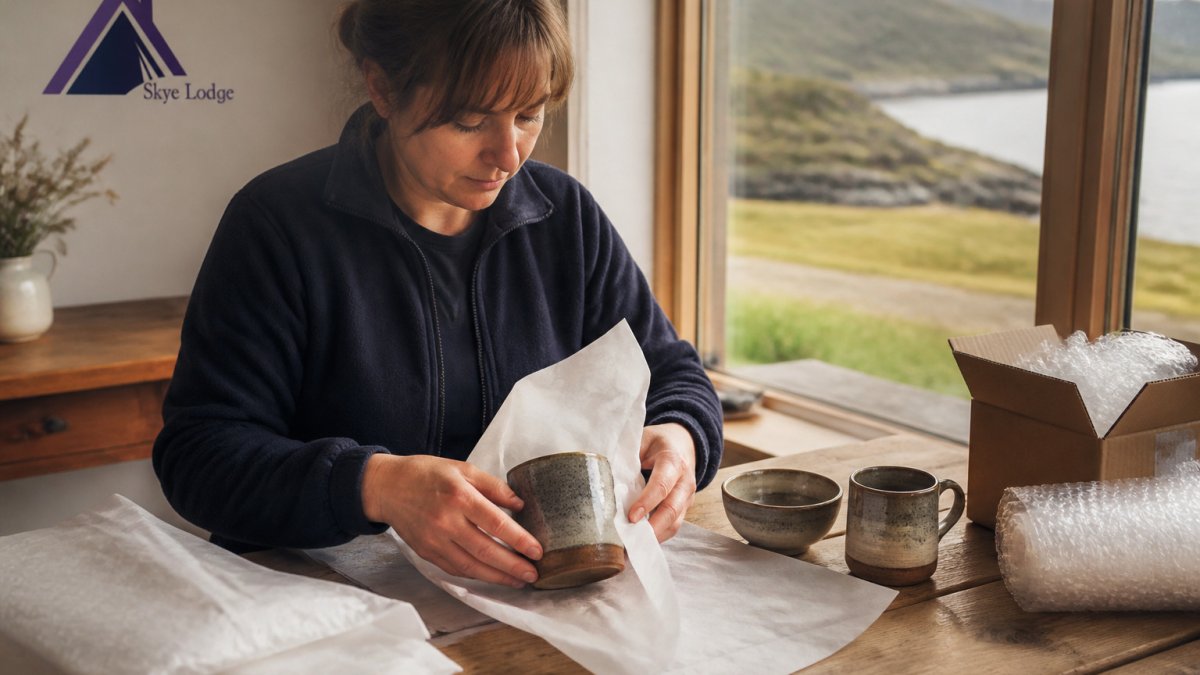
Wrap every item individually. Shared wrapping lets pieces knock together, and a single crack can spread. The general method below works for most pieces, and the shape-by-shape notes that follow adapt it for the forms that break most often.
The general method
- Place a layer of acid-free tissue paper around the whole piece, covering any glaze that could scratch.
- Wrap bubble wrap around the piece, making at least two full turns.
- Tape the bubble wrap in place, but keep the tape off the glaze itself.
- Check that you cannot feel any bare patches where the piece might touch something hard.
- Place the wrapped piece in its own snug box, and fill any gap with crumpled tissue or clothing.
Good practice: pick a box that fits the piece with a little cushioning on each side, not a loose box that lets it rattle.
Mugs and cups
The handle is the weak point. Wrap the handle separately with extra tissue before wrapping the main body, and make sure the handle points inward and away from the box wall. Stuff the inside of the mug with crumpled tissue so the walls cannot flex inward, then wrap the whole piece. A mug packed handle-out will often lose its handle on the first bump.
Bowls
Bowls are strong in the base and fragile at the rim. Wrap the rim with a folded strip of bubble wrap before wrapping the body, and nestle smaller bowls inside larger ones only if each is separately wrapped and padded. Never stack unwrapped bowls inside one another; the foot of one bowl will chip the inside of the next.
Plates and platters
Plates are the most common casualties because they stack and flex under pressure. Learning how to pack fragile artisan ceramics for travel starts with this: do not stack them loosely. Wrap each plate individually, then stand plates on their edge in a box, like files in a drawer. Add a cardboard divider between each plate so they cannot rub together, and use a shallow box so the stack cannot shift.
Vases and tall vessels
A tall vase is a lever: a small knock at the top travels down the whole piece. Wrap the neck and rim with extra padding, then wrap the body. Pack the vase upright in a box that supports the sides, and fill the inside with crumpled tissue so the walls cannot collapse inward. If the vase is very tall, consider a padded case in the cabin rather than a suitcase, where it will be less likely to be crushed by other luggage.
Lidded vessels and pots
A lid that shifts in transit can chip the rim it sits on. Remove the lid if it comes off cleanly, wrap it separately, and pack it beside the body rather than on top. If the lid is fixed or part of the design, pad the join with tissue so the lid cannot rattle, and wrap the whole piece as one.
Thin rims and spouts
Teapots, jugs and pourers break at the spout and the rim. Pad the spout with rolled tissue, making sure the spout points inward and away from the box wall, and cover rims with a folded strip of foam or bubble wrap so nothing presses against the lip. Never let a handle or spout carry the weight of the piece.
Protecting handles, rims and spouts in general
These parts break first. A handle that catches the edge of a box will snap off with little force. Wrap handles separately with extra tissue before wrapping the main body, cover rims with a folded strip of foam or bubble wrap, and pad spouts with rolled tissue.
Each piece needs a slightly different approach, and the weak points differ by shape. The table below summarises the main ones.
| Piece | Weak point | Key protection |
|---|---|---|
| Mugs and cups | Handle | Wrap handle separately, stuff interior |
| Bowls | Rim | Fold bubble wrap strip around rim |
| Plates and platters | Stacking pressure | Stand on edge with dividers |
| Vases and tall vessels | Neck and rim | Extra padding, pack upright |
| Lidded vessels and pots | Lid rim | Wrap lid separately, pack beside body |
| Teapots and jugs | Spout and rim | Pad spout inward, cover rims |
Packing Ceramic Plates and Flat Pieces Safely
Plates and platters are the most common casualties, because they stack and flex under pressure. Do not stack them loosely. Instead:
- Wrap each plate individually, then stand plates on their edge in a box, like files in a drawer
- Add a cardboard divider between each plate so they cannot rub together
- Use a shallow box so the stack cannot shift and the weight stays low
Standing plates on edge keeps the pressure off the glaze and spreads any impact across the whole stack rather than one point.
Packing Pottery in a Suitcase Without Movement
Movement is the silent danger. Even a well-wrapped piece will break if it slides into a hard corner during a bumpy road journey. Once your pieces are in their boxes, fill every gap:
- Place boxes in the centre of the case, surrounded by soft clothing on all sides
- Put heavy items such as shoes or books on the outside, away from the fragile core
- Stuff any empty space with towels, jumpers or socks so nothing can shift
- Close the case gently and test it by lifting one end, then shaking it lightly. If you hear anything move, add more padding
Tying the bag handles to the box with a little jute twine can help hold a stacked arrangement steady, but keep the twine loose enough that it does not crush the cardboard.
Unpacking and Checking Your Pieces at Your Destination
Do not rush the unpacking. Find a clear, flat surface, ideally a table with a soft cloth, and work slowly.
Check each piece in good light for hairline cracks, chips or loose handles. Keep all the packaging until you are satisfied, in case you need to make a claim.
Once your pieces are safely unpacked, you may want a restful break.
Booking Your Stay and Planning Your Next Steps on Skye
Once your pieces have arrived safely, it is time to think about the rest of your trip. You can see our rooms and book a suitable one for your visit.
Many guests find that a longer stay suits the island best. If your plans allow, you can learn more about why a three-night or longer stay makes sense on Skye. Before you book, explore Dunvegan's attractions and nearby stays to plan your days. To start, visit the Skye Lodge homepage for an overview of what we offer.
Whatever your plans, drive carefully on the single-track roads, and allow extra time for every journey. We look forward to welcoming you.
Frequently Asked Questions
Can I fly with ceramics in my carry-on?
Often you can, but it depends on the airline, the size and weight of your bag, and how the item is packed. Hand luggage limits and rules vary between carriers, so check your airline's baggage policy before you travel. Fragile pieces are safer in carry-on where you can keep them with you and watch them, rather than in the hold where they may be handled roughly. Pack each piece snugly, cushion the empty space, and label the bag as fragile where the airline allows it.
Should fragile ceramics go in carry-on or checked luggage?
For irreplaceable or heavily glazed artisan pieces, carry-on is usually the safer choice because you control the handling. Larger or heavier items may need to go in checked luggage, in which case use a rigid outer case or box with a snug inner box and plenty of cushioning. Whichever you choose, keep your most valuable pieces away from the outer edges of the bag and avoid overpacking, since a tightly filled case protects better than one with loose space.
Is bubble wrap or clothing better for protecting pottery?
Use both, but for different jobs. Wrap each piece individually in tissue or bubble wrap first, since clothing alone can compress unevenly and does not protect handles or rims well. Soft clothing works well as additional padding around the wrapped pieces and to fill gaps. Make sure nothing shifts when you shake the case gently, because movement is what causes most breakage.
How do I pack ceramic plates so they do not break?
Wrap each plate individually, then stand them on edge rather than stacking them flat, which spreads any impact across the rim. Place a sheet of cardboard or padding between plates, and keep the stack small enough that it cannot shift. Put the plates in the centre of the case, surrounded by clothing or soft items, so there is no room for them to move.
Skye Lodge is ready to host your stay on the Isle of Skye, with the rest of your packing done and your ceramics in safe hands.