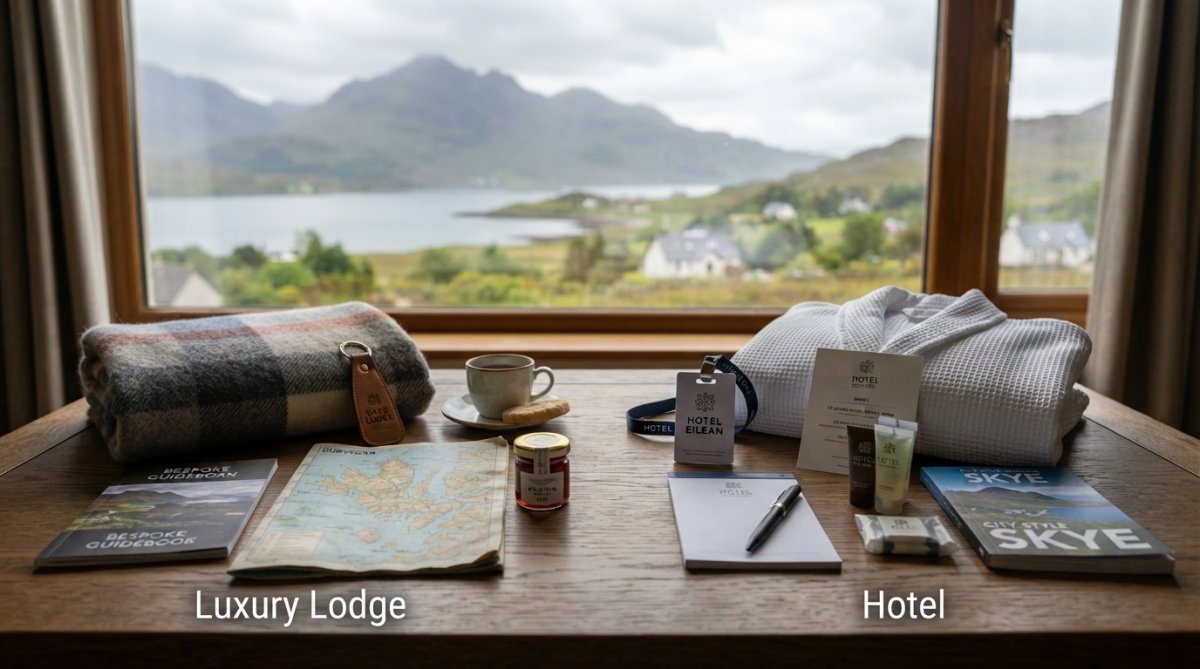
 comparison
Luxury Lodge vs Hotel Isle of Skye: Which Suits You Best?
Table of Contents
- Luxury Lodge vs Hotel Isle of Skye: Key Differences at a Glance
- The Core Distinction: Service Model and Atmosphere
- Isle of Skye Luxury Accommodation: Hotels Explained
- Self-Catering Lodges Isle of Skye: The Private Retreat Model
- Isle of Skye Hotels with Views: Scenic Settings Compared
- Unique Stays Isle of Skye: Bespoke Experiences and Local Knowledge
- Logistical Accessibility: Getting Around the Scottish Highlands
- Privacy vs Social Atmosphere: Which Suits Your Travel Style
- Making Your Choice: Luxury Lodge vs Hotel for Your Isle of Skye Stay
- Frequently Asked Questions
Last Updated: July 28, 2026
Luxury Lodge vs Hotel Isle of Skye: Key Differences at a Glance
When planning a stay on Scotland's most dramatic island, the choice between a luxury lodge vs hotel Isle Skye fundamentally shapes your experience. According to Scottish Tourism Board 2026 accommodation trends, lodge bookings on the Isle of Skye have increased significantly as travellers seek more personalised, intimate experiences away from traditional hospitality structures.
The core distinction lies in service model and atmosphere. Hotels operate on a standardised framework: front desk, daily housekeeping, structured dining, concierge services. Lodges trade standardisation for bespoke personalisation, you're a guest in someone's carefully curated space, not a room number.
| Accommodation Type | Service Model | Best For | Atmosphere |
|---|---|---|---|
| Luxury Hotel | Full-service with structured amenities | Couples wanting convenience and dining | Social, professional |
| Self-Catering Lodge | Independent with owner guidance | Groups and families seeking privacy | Intimate, peaceful |
| Boutique Lodge | Hybrid: personal touch with select services | Individuals wanting luxury without formality | Refined, relaxed |
This comparison matters because Isle of Skye luxury accommodation isn't one-size-fits-all. The island's geography, weather, and isolation make the choice between hotel convenience and lodge independence genuinely consequential.
The Core Distinction: Service Model and Atmosphere
Hotels on Skye operate within a familiar framework. You check in at a desk, access structured services, restaurants, bars, housekeeping, concierge, and experience predictable, reliable hospitality designed for convenience.
Self-catering lodges invert this model. You arrive to a property that feels like a private home. There's no front desk or daily cleaning unless arranged. Instead, you have a fully equipped kitchen, autonomy over your schedule, and direct access to owners or managers who know the island intimately. Skye Lodge Dunvegan exemplifies this: owners Claire and Douglas provide personalised guidance, handmade beds in every room, and gourmet breakfasts using locally sourced ingredients prepared fresh each morning.
The atmosphere difference is profound. Hotels create social environments where you share dining spaces and encounter other guests. Lodges create sanctuary, you control who you interact with and how deeply.
Isle of Skye Luxury Accommodation: Hotels Explained
Luxury on Skye means lochside or coastal positioning, fine dining with local ingredients, and service standards that acknowledge the island's remoteness. A luxury hotel here competes on location, culinary excellence, and hospitality quality rather than size or amenity density.
Kinloch Lodge, on the shores of Loch Na Dal, combines Highland hospitality with world-renowned fine dining. The restaurant focuses on local produce; the 15 rooms include sea-view options. At approximately £697 per night, it positions itself as a destination restaurant with accommodation, guests arrive for the culinary experience; the rooms provide the framework to stay.
Duisdale House Hotel on the southern Sleat Peninsula offers an accessible luxury formula. Award-winning restaurant, individually styled rooms with deluxe sea-view options, and breathtaking views over the sea loch. Starting from approximately £125 per night, it blurs the line between hotel and lodge accommodation, giving guests choice within the hotel structure.
Both properties share a critical advantage: everything is handled for you. Dinner reservations, transport, and local knowledge are dispensed by trained staff.
Self-Catering Lodges Isle of Skye: The Private Retreat Model
Self-catering lodges represent a fundamentally different philosophy. You're renting a home, not a room. This model appeals to groups, families, and individuals who value autonomy over service density.
Broadford Lodges Skye exemplifies modern self-catering. Modern, stylish, dog-friendly, fully equipped kitchens in a convenient village location. You cook when you want, eat what you choose, and set your own schedule. The self-catering model suits longer stays particularly well, a week costs less than seven hotel nights while offering flexibility that justifies the trade-off in service.
Skye Lodge Dunvegan occupies a hybrid position. It's technically self-catering, offering independence and privacy, but operates with boutique hospitality standards. Gourmet breakfasts are prepared fresh from locally sourced ingredients. Owners provide bespoke guidance on local attractions, dining, and travel planning. You get lodge privacy with selective service elements that enhance rather than dictate your experience. This suits individuals and small groups (4-10 persons) seeking luxury without formality.
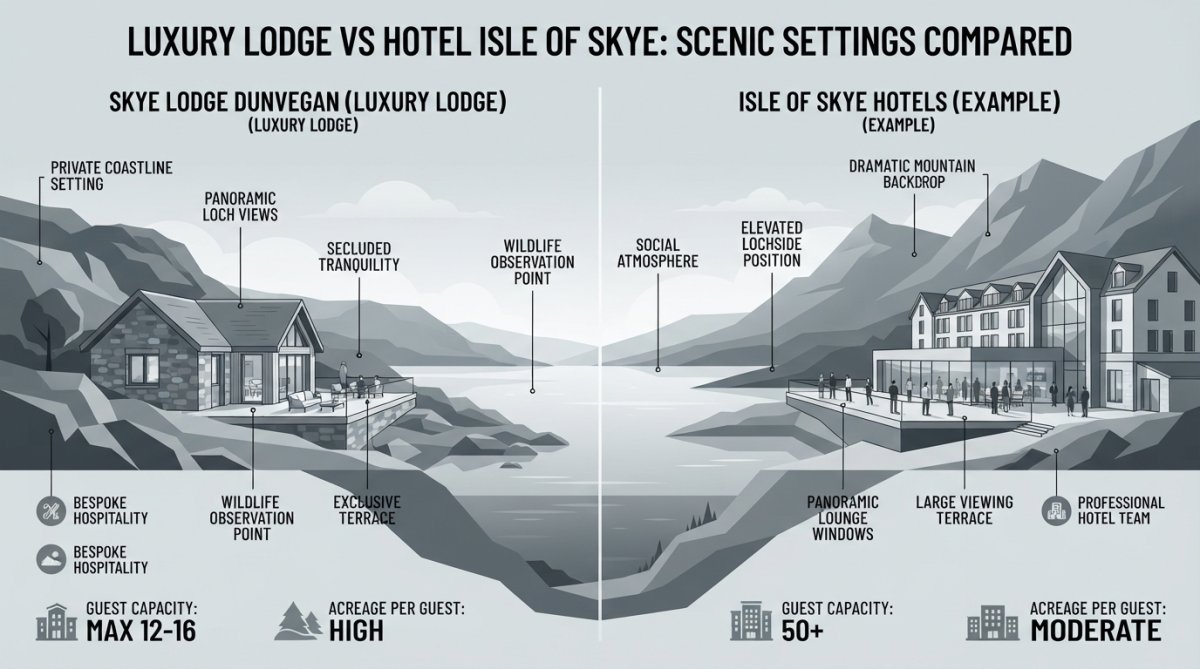
Isle of Skye Hotels with Views: Scenic Settings Compared
Location determines half the luxury experience on Skye. Hotels and lodges positioned on lochs or coasts have inherent advantages; inland properties fight against geography.
Lochside locations offer stillness. Kinloch Lodge on Loch Na Dal provides quiet, reflective settings with mountains across the water and minimal development visible. Coastal locations offer drama, Neist Point near Skye Lodge Dunvegan features cliffs, lighthouse, and Atlantic views. The Trotternish Peninsula offers otherworldly geology with the Old Man of Storr and the Quiraing. Sleat Peninsula properties like Duisdale House position themselves between these extremes, offering sea views without coastal drama.
Proximity is practical but crucial. A lodge near Dunvegan Castle, Neist Point, and the Cuillin mountains means your morning hike starts 10 minutes after breakfast. A lodge 45 minutes away requires deliberate planning. For hotels, concierge arranges transport; for lodges, you manage logistics yourself.
Unique Stays Isle of Skye: Bespoke Experiences and Local Knowledge
The distinction between standardised hotel experience and truly bespoke lodge stay comes down to local knowledge and personalised engagement. Hotels employ trained staff following protocols; owner-run lodges provide knowledge earned through years of living on the island.
Skye Lodge Dunvegan provides this through direct owner engagement. Claire and Douglas know which restaurants are worth the drive, which local artisans merit visiting, which viewpoints capture sunrise and sunset optimally. This knowledge is shared through conversation and genuine recommendation rather than standardised information packets.
Dining recommendations illustrate the difference. The Three Chimneys, Stein Inn, and Edinbane Lodge are all within 15 minutes of Skye Lodge Dunvegan. A hotel can book reservations; the Skye Lodge owners can tell you which dishes to order, which tables have the best views, and whether the chef is experimenting with new menus.
Research from Scottish tourism visitor experience studies 2026 indicates that travellers staying 3-5 nights on Skye report significantly higher satisfaction when exploring fewer locations deeply rather than attempting to see everything. Skye Lodge recommends a 3-night, 5-day plan prioritising depth over breadth. A hotel can provide this itinerary; the owners can explain why it matters and what you'll discover.
Logistical Accessibility: Getting Around the Scottish Highlands
Highland roads are single-track routes with passing places, dramatic elevation changes, and weather that shifts hourly. This geography affects your accommodation choice significantly.
Hotels in larger settlements, Portree, Broadford, Dunvegan, have easier road access. You're never more than 45 minutes from a major town. Restaurants, shops, and fuel are nearby. Transport services and guided tours operate from these hubs; booking activities is straightforward.
Remote lodges require more deliberate planning. Skye Lodge Dunvegan is positioned for dramatic landscape access but requires commitment to the journey. Add 20 minutes to every hour of travel time, a 30-minute drive becomes 50 minutes.
For lodge stays, plan restaurant bookings, activity reservations, and supply runs in advance. You can't decide at 5 p.m. to drive to a restaurant 30 minutes away and expect availability. Concierge support mitigates this. Skye Lodge provides detailed guidance on timing, routing, and planning from people who actually live there.
Privacy vs Social Atmosphere: Which Suits Your Travel Style
Hotels and lodges serve fundamentally different social needs. Hotels create social infrastructure where you share dining spaces and encounter other guests. For couples seeking romance, this can feel intrusive. For solo travellers or groups, it creates community.
Lodges eliminate this entirely. You're alone with chosen companions. Social interaction happens only if you initiate it. For groups of friends or families, this is liberation.
Skye Lodge Dunvegan offers a middle path. It's private, you're not sharing dining spaces with other guests, but owners are present and available. If you want conversation and local guidance, it's there. If you want solitude, that's equally available.
Exclusive group bookings represent another consideration. Hotels scatter groups across multiple rooms with shared facilities. Skye Lodge can accommodate 8 friends with exclusive use of the entire property, private dining, and complete autonomy. This changes the equation entirely for groups seeking genuine privacy.
Making Your Choice: Luxury Lodge vs Hotel for Your Isle of Skye Stay
Choose a hotel if you value convenience, structured dining, and professional service. Kinloch Lodge suits culinary-focused travellers; Duisdale House suits those wanting accessible luxury with flexible room options.
Choose a self-catering lodge if you value independence, cost efficiency, and control. Broadford Lodges suit families and groups; the model scales well for longer stays.
Choose a boutique lodge like Skye Lodge Dunvegan if you want privacy with selective service, personalised local knowledge, and a bespoke experience. You want gourmet breakfasts prepared fresh, guidance from people who live on the island, and flexibility to explore at your own pace. This suits individuals, couples, and small groups (4-10 persons) seeking sophisticated retreat.
Seasonal timing affects your choice. Summer brings crowds and higher prices; hotels manage volume efficiently. Winter brings isolation and dramatic weather; lodges with owner support handle this better. Spring and autumn offer balance.
Booking advice: hotels require less advance planning but fill quickly during peak season. Lodges offer more flexibility but require more planning for logistics. Book restaurants 2-3 weeks ahead regardless of accommodation type.
The honest assessment: if you have 2-3 nights and want minimal planning, a hotel works. If you have 3-5 nights and want to experience the island properly, a lodge with owner guidance like Skye Lodge Dunvegan provides optimal balance of luxury, autonomy, and local knowledge.
The choice between luxury lodge vs hotel Isle Skye reflects how you want to spend your time on Scotland's most dramatic island. If you're seeking a sophisticated retreat where owners understand the landscape intimately and guide you toward genuine discovery, Skye Lodge Dunvegan offers handmade beds in every room, gourmet breakfasts prepared fresh with locally sourced ingredients, and bespoke hospitality from owners who live on the island. The property accommodates 4-10 persons for individuals or exclusive group bookings, positioned near Dunvegan Castle, Neist Point, and the Cuillin mountains. Scottish island accommodation comparison guide 2026 confirms that owner-operated lodges consistently receive higher satisfaction ratings than standardised hotel chains for travellers seeking authentic Highland experiences. Make a reservation at Skye Lodge and experience the difference between staying on Skye and truly discovering it.
Frequently Asked Questions
What is the main difference between a luxury lodge and a hotel on the Isle of Skye?
The primary distinction lies in service model and atmosphere. Luxury hotels on Isle of Skye, such as Kinloch Lodge and Duisdale House, offer full-service hospitality with on-site restaurants, daily housekeeping, concierge services, and a social dining environment. Luxury lodges, like Skye Lodge, typically accommodate smaller groups (4-10 persons), provide bespoke, personalised hospitality from owners, and emphasise privacy and exclusive use. Hotels suit those seeking traditional hospitality standards and fine dining; lodges cater to guests prioritising tranquillity, privacy, and intimate, owner-led experiences.
Are self-catering lodges on the Isle of Skye suitable for families or groups seeking luxury accommodation?
Yes. Self-catering lodges like Broadford Lodges offer flexibility, independence, and privacy ideal for families and groups. However, luxury self-catering lodges differ from standard self-catering by providing curated touches, handmade beds, gourmet breakfast ingredients, locally sourced provisions, and owner guidance on local attractions. Skye Lodge exemplifies this model, accommodating exclusive group bookings of 4-10 persons with personalised service. Self-catering suits travellers who value autonomy, longer stays, and the ability to dine privately, whilst still accessing luxury comfort and local knowledge.
Which offers better views: luxury lodges or hotels on the Isle of Skye?
Both can offer exceptional views, depending on location. Hotels like Kinloch Lodge command lochside positions with spectacular sea and mountain vistas, whilst Duisdale House overlooks sea lochs from Sleat Peninsula. Skye Lodge sits on the westerly coastline with loch views and proximity to iconic landmarks like Dunvegan Castle and Neist Point. The difference isn't view quality but setting: hotels typically position guests in shared viewing spaces (dining rooms, lounges), whilst lodges often provide private terraces or windows for intimate landscape appreciation. Your choice depends on whether you prefer communal scenic experiences or private contemplation.
How do I plan my itinerary if I stay at a luxury lodge on the Isle of Skye?
Luxury lodges provide significant logistical support. Owners like those at Skye Lodge offer local knowledge, restaurant recommendations, and itinerary guidance, particularly valuable since Highland roads require adding 20 minutes to every hour of travel time. Lodges can advise on sunrise and sunset viewing locations, book restaurants in advance (essential for popular venues like The Three Chimneys), and connect guests with local artisans and craftspeople. Hotels offer concierge services similarly, but lodge owners often provide more bespoke, personalised planning tailored to your specific interests, whether culinary, cultural, or adventure-focused.
What amenities should I expect at a luxury lodge versus a hotel on the Isle of Skye?
Luxury hotels provide comprehensive amenities: on-site fine dining restaurants, beauty centres, daily housekeeping, Wi-Fi, luxury toiletries, and concierge services. Lodges prioritise differently: expect handmade beds, ensuite rooms, gourmet breakfasts with locally sourced ingredients, and personalised hospitality, but typically without on-site restaurants or daily cleaning. Some lodges (like Skye Lodge) function as exclusive retreats, meaning you may be the only guests present, offering unparalleled privacy. Hotels suit guests seeking traditional luxury services; lodges appeal to those valuing intimate comfort, owner engagement, and peaceful seclusion over conventional amenities.