 How-to
9 Things to Know Before Walking the Old Man of Storr with Your Dog
Last Updated: October 25, 2026
Quick Summary
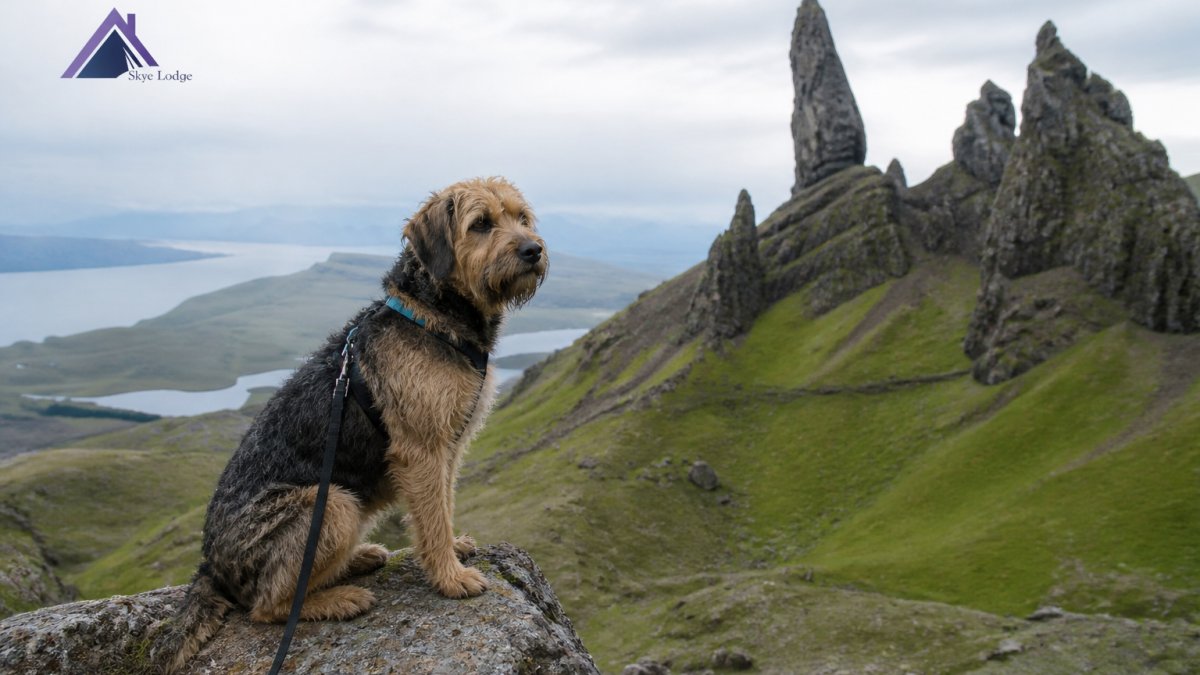
Yes, the Old Man of Storr dog walk is dog friendly, and dogs are welcome on the path. Keep your dog on a fixed-length lead of around 1.5 to 2 metres for the whole route, because the open hillside has free-roaming sheep and no fence lines.
- The out-and-back route to the viewpoint runs roughly 3.8 km and takes one and a half to two hours.
- Plan two hours to allow for photos, a slow dog and the climb.
- The trail is a steady ascent with loose gravel and rocky steps, and most slips happen on the descent.
- Shorten the lead and stand still if an off-lead dog approaches, and step to the uphill side.
- If your dog is elderly, very young or nervous, choose a gentler walk instead.
Table of Contents
- Is the Old Man of Storr Hike Dog Friendly?
- Old Man of Storr Walk Distance and Duration
- Old Man of Storr Trail Difficulty: What Your Dog Faces
- A Section-by-Section Leash Plan for the Trail
- Dog Walking Etiquette on Skye: Sheep, Livestock and the Outdoor Access Code
- Is Your Dog Suited to the Climb? A Suitability Checklist
- Dog-Friendly Walks on the Isle of Skye Beyond the Storr
- Planning Your Dog-Friendly Stay Near Dunvegan
- Frequently Asked Questions
Is the Old Man of Storr Hike Dog Friendly?
Yes, the Old Man of Storr dog walk is a friendly one. Dogs are welcome on this walk, and you will meet plenty of them on the path. That single fact hides the real question, though.
We run Skye Lodge near Dunvegan, and guests ask us this constantly. So here is the honest version, from people who know the ground and the weather.
The walk climbs steeply, crosses open hillside and passes free-roaming sheep. Your dog needs to cope with all three.
Old Man of Storr Walk Distance and Duration
The out-and-back route to the viewpoint runs roughly 3.8 km and takes most walkers one and a half to two hours. Add time for photos, a slow dog and the climb, and two hours is a sensible plan.
The path starts at the car park off the A855 and climbs through forestry before opening onto hillside. It is a steady ascent, not a scramble, but the gradient bites.
For a detailed route and layout, see our Old Man of Storr trail map and hiking guide. It shows the path clearly, so you can judge the climb before you commit.
Here are the key numbers to plan around before you set out with your dog.
| Item | Value | Note |
|---|---|---|
| Route distance | Roughly 3.8 km | Out-and-back to the viewpoint |
| Typical duration | One and a half to two hours | For most walkers |
| Sensible plan | Two hours | Allows for photos, a slow dog and the climb |
| Trailhead | Car park off the A855 | Path climbs through forestry then opens onto hillside |
| Gradient | Steady ascent, not a scramble | The gradient bites |
Old Man of Storr Trail Difficulty: What Your Dog Faces
The Old Man of Storr trail difficulty is moderate for people and harder for dogs. Steep sections, loose gravel and rocky steps make up much of the upper path. There is little shade and no water source.
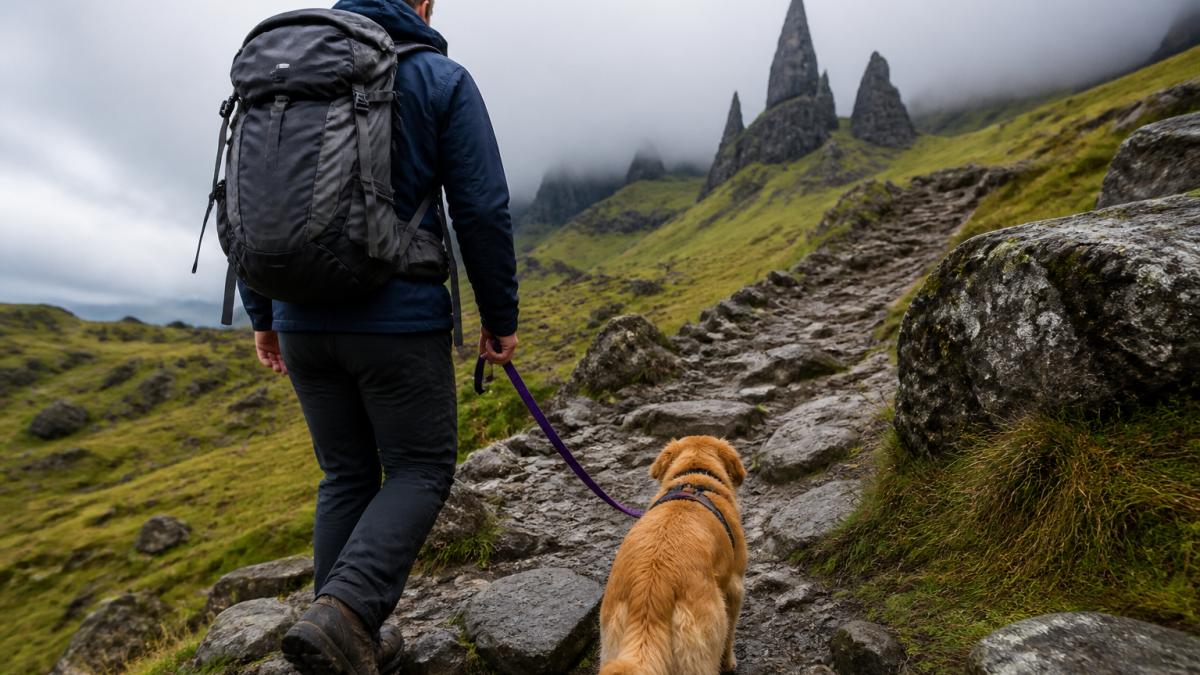
Above the tree line, the terrain is open and exposed. Wind and rain arrive fast here. A common mistake is judging the walk by the car park weather. Conditions change as you climb.
Watch out: rocky sections can cut paw pads, and the descent is where most slips happen. Take it slowly on the way down.
A Section-by-Section Leash Plan for the Trail
Keep your dog on a lead for the whole walk. That is our clear recommendation, and it removes the guesswork. Here is how we would handle each stretch, and why.
- Car park to forestry: lead on from the moment you leave the car. The car park is busy, cars manoeuvre unpredictably, and other dogs arrive excited. A short lead here prevents the most common incident on the hill, a dog slipping its collar in a crowded car park.
- Forestry section: short lead, close control. The trees funnel walkers together, so you will pass people and dogs at close quarters. Keep your dog on the downhill side of the path and shorten the lead as you approach.
- Open hillside: lead on, sheep may be grazing anywhere. This is the stretch where an off-lead dog causes the most trouble, because there is no fence line and sheep appear over rises without warning.
- Rocky upper path: lead on and shortened. On steps and loose gravel, a long lead tangles around legs and rocks. Hold the lead short and low, and let your dog pick its own line rather than pulling it up the steps.
- Viewpoint: lead on, space is tight and busy. The viewing area is small and often crowded with photographers. Keep your dog close and do not let it approach the edge.
- Descent: lead on, steady pace, watch loose gravel. Most slips happen on the way down, when tired legs and loose stone combine. A short lead gives you a hand free for balance.
Why the lead stays on
An off-lead dog on this hill is a risk to sheep, to other walkers and to itself. The open hillside has no boundaries, sheep graze throughout, and the ground drops away in places.
There is also a legal dimension. Under the Scottish Outdoor Access Code, access rights come with responsibilities, and keeping your dog under control around livestock is central to those responsibilities. A short lead is the simplest way to meet that duty on a hill like this.
How to manage the lead in practice
A standard long training lead is the wrong tool here. Use a fixed-length lead of around 1.5 to 2 metres, or a shorter training lead, and hold it in one hand with the slack gathered rather than looped around your wrist. On steep sections, a harness gives you more control than a collar and takes pressure off your dog's neck on the climb.
If you meet an off-lead dog coming the other way, step to the uphill side of the path, shorten your lead and stand still until it passes. Do not assume the other owner will recall their dog, plan for the opposite.
Dog Walking Etiquette on Skye: Sheep, Livestock and the Outdoor Access Code
Free-roaming sheep are the single biggest concern on this walk. They graze the open hillside and appear without warning, over a rise, out of a hollow, or just off the path where the ground folds. A dog that chases livestock can cause serious harm, and the consequences fall on the owner.
Dog walking etiquette on Skye comes down to control. Under the Scottish Outdoor Access Code, you have a responsibility to keep your dog under control around livestock.
A livestock encounter protocol
Use the same sequence every time, so it becomes automatic:
- Spot the sheep early. Scan ahead as the path opens up. Sheep are often the same colour as the rock and bracken, so look for movement rather than shape.
- Shorten the lead before you are close. Gather the slack and bring your dog to your side, on the downhill side of the path if possible.
- Give the sheep room. Walk wide around them rather than through the middle of the flock. Sheep will usually move off if you give them a clear line.
- Keep moving and stay calm. Do not stop to take photos with sheep in the frame if your dog is alert to them. A steady, quiet passage is less stressful for the animals and for your dog.
- If a sheep blocks the path, wait at a distance and let it move on, or find a wide line around it. Do not let your dog approach to "say hello".
Why this matters beyond etiquette
Sheep on the hill are working animals, and disturbance at the wrong time of year, lambing especially, can have serious consequences for the flock. Responsible access keeps these hills open to everyone, and dog owners who manage their animals well are part of that.
If you are unsure how your dog will behave around sheep, test the waters on a shorter walk first. Our guide to beautiful walks in and around Dunvegan includes routes where you can build up to the bigger hills.
Is Your Dog Suited to the Climb? A Suitability Checklist
Not every dog belongs on this hill, and that is fine. Use this checklist before you set out.
- Your dog is comfortable on a lead around livestock
- It can manage a steady climb of an hour or more
- It is fit and healthy, with no joint or breathing issues
- It copes with wind, rain and open, exposed ground
- It is not easily spooked by other dogs or people
- You can carry water and a bowl for it
If you tick most boxes, go for it. If your dog is elderly, very young or nervous, a gentler walk is the kinder choice. Practical dog preparation matters as much as the route itself.
Dog-Friendly Walks on the Isle of Skye Beyond the Storr
Plenty of gentler dog-friendly walks on the Isle of Skye suit dogs who are not ready for the Storr. Lower-level paths and woodland tracks give you the scenery without the steep climb.
Dunvegan is a good base for these. If you are weighing up where to stay, our guide on whether Dunvegan is a good base for hiking explains the options.
Shorter, flatter walks are also easier on paws and joints. Save the big climbs for a dog in its prime.
Planning Your Dog-Friendly Stay Near Dunvegan
A comfortable base makes the whole trip easier, especially with a dog in tow. After a hill day, your dog wants somewhere calm to settle, and you want somewhere restful too.
At Skye Lodge, we offer handmade beds, en-suite rooms and a freshly prepared breakfast each morning. We are happy to share local knowledge on routes and dog-friendly spots.
If you are travelling with a dog, see our pet-friendly accommodation with breakfast to check what we offer. You can also view our rooms and book your stay directly.
Frequently Asked Questions
Can dogs go on the Old Man of Storr hike?
Yes. Dogs are welcome on the Old Man of Storr walk and there is no ban on the route. The caveats are practical rather than legal: the path climbs steeply with rocky sections, and free-roaming sheep graze the open hillside. Under the Scottish Outdoor Access Code you should keep your dog under close control and on a short lead around livestock. Fit, well-socialised dogs generally manage the walk well; very young, elderly or reactive dogs may find it stressful.
Are dogs allowed off the lead at the Old Man of Storr?
Off-lead walking is not appropriate on this route. Sheep roam the hillside above the tree line and the path is busy with walkers, so a short lead keeps your dog safe and avoids conflict with livestock. The Scottish Outdoor Access Code expects dogs to be under close control at all times and on a short lead where sheep are present. Treat the whole climb as an on-lead outing and you will avoid the most common problems.
How long does the Old Man of Storr hike take with a dog?
Most walkers reach the viewpoint in around one and a half to two hours for the full circular route, allowing for stops. With a dog, add time for sniffing, water breaks and slower progress on the steep sections. The climb is short in distance but steady, so build in extra margin if your dog is not used to hill walking. Allow a relaxed half day rather than squeezing it between other stops.
Are there other dog-friendly walks near Dunvegan?
Plenty. The paths around Loch Dunvegan, woodland and shoreline routes near Dunvegan Castle, and quieter stretches of coast on the westerly side of the island all suit dogs. These are generally gentler than the Storr and easier to fit around a relaxed stay. Ask at your accommodation for current conditions and which routes have livestock nearby, as grazing patterns change through the season.
The Old Man of Storr rewards the effort, and a well-prepared dog can enjoy it alongside you. The key is honest judgement: a steady lead, respect for the sheep, and a base that suits you both. At Skye Lodge, we offer handmade beds, en-suite rooms and a gourmet breakfast to set you up for the day. Get started with Skye Lodge and plan a stay that works for you and your dog.