 Listicle
Scenic Photography Spots Isle of Skye: 7 Best Locations
Last Updated: October 23, 2026
Quick Summary
The best scenic photography spots on the Isle of Skye include the Old Man of Storr, Quiraing, Neist Point Lighthouse, the Fairy Pools and Glen Brittle, Fairy Glen, Sligachan Bridge, and Kilt Rock. For scenic photography, match each location to its light: sunrise at the east-facing Old Man of Storr, sunset at west-facing Neist Point, and overcast days at the Fairy Pools.
- The walk from the Old Man of Storr car park climbs for roughly 45 minutes to an hour.
- Add 20 minutes to every hour of travel on single-track roads to the Quiraing.
- Arrive at Neist Point at least an hour before sunset to walk down and set up.
- Bring a polarising filter and small tripod for half-second or longer exposures at the Fairy Pools.
- Plan at least one sunrise and one sunset into every full day on Skye.
Table of Contents
- 1. Old Man of Storr: The Iconic Trotternish Ridge
- 2. Quiraing: Dramatic Landscapes and Viewpoints
- 3. Neist Point Lighthouse: Coastal Cliffs and Sunset
- 4. Fairy Pools and Glen Brittle: Waterfalls and Cuillin Views
- 5. Fairy Glen and Sligachan Bridge: Unique Rock Formations
- 6. Kilt Rock and the Cuillin Mountains: Waterfall and Mountain Scenery
- 7. Planning Your Isle of Skye Photography Locations
- The Best Time for Photography on Skye: Light, Weather and Seasons
- Frequently Asked Questions
1. Old Man of Storr: The Iconic Trotternish Ridge
The walk from the car park climbs steadily for roughly 45 minutes to an hour before the rock formations open up properly. Most photographers stop too early.
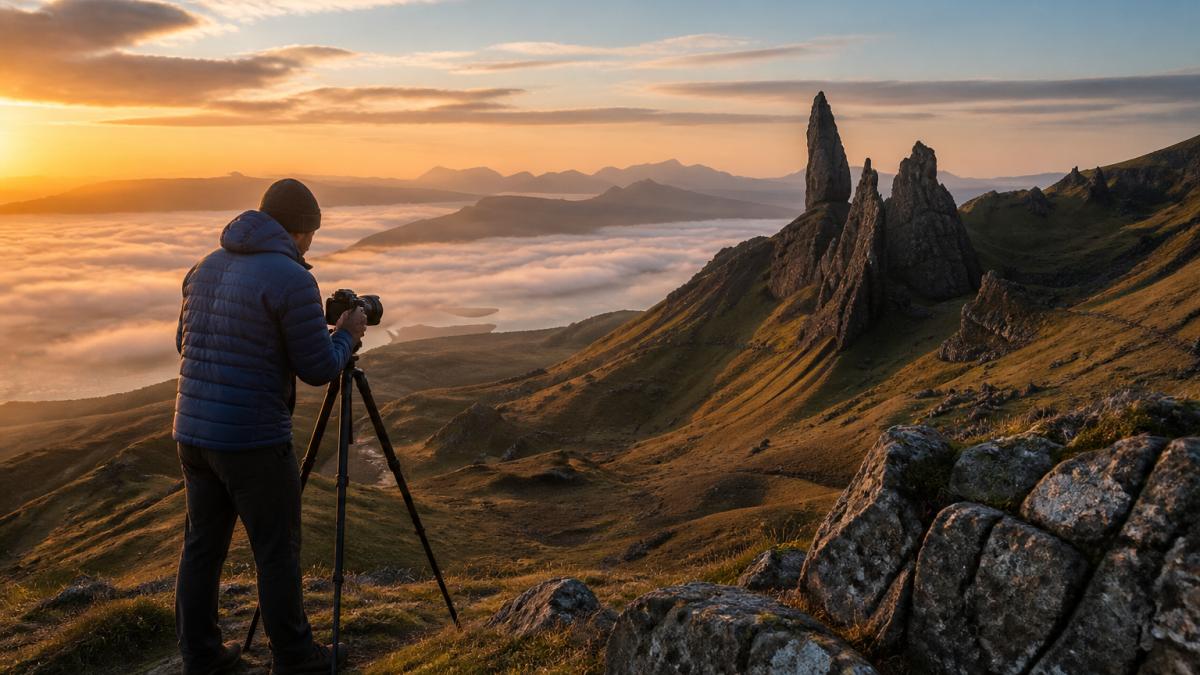
Composition and Focal Length Tips
A 24-70mm lens covers most of what you will want here. Shoot wide at 24mm to include the full pinnacle and the ridge line, then switch to 70mm to compress the Old Man against the distant Cuillin.
- Foreground interest: use the scattered boulders below the formation to anchor the frame
- Vertical format: works better than horizontal for the pinnacle itself
- Long exposure: a 10-stop filter turns moving cloud into streaks behind the rock
- Avoid the obvious: the car-park viewpoint shot appears everywhere; walk five minutes further
If you want the full route, walking distances and a printable trail map, our guide to the Old Man of Storr trail map covers the walk in detail.
A common mistake is arriving at midday and shooting into flat light. The Old Man faces east, so sunrise lights the rock face directly. Sunset leaves it in shadow.
2. Quiraing: Dramatic Landscapes and Viewpoints
Quiraing rewards the photographer who gets up early. This is a landslip landscape of ridges, hidden plateaus and pinnacles on the northern Trotternish Ridge, and it is the most cinematic scenery on the island.
The single-track road to the Quiraing car park climbs steeply and passes passing places you will need to use. Add 20 minutes to every hour of travel on these roads, as we tell every guest at Skye Lodge, because the drive takes longer than the map suggests.
Composition here is about layers. Use a 70-200mm lens to stack the ridges one behind another, or a wide lens with a foreground rock to give the scene depth.
3. Neist Point Lighthouse: Coastal Cliffs and Sunset
Neist Point is the best sunset location on the west coast. The lighthouse sits at the end of a headland below tall cliffs, and the walk down the stepped path takes around 20 minutes each way.
The light here changes fast. Arrive at least an hour before sunset to walk down, choose your position and set up.
If you are planning a dedicated evening here, our guide to how long to spend at Neist Point Lighthouse helps you time the visit around the light and the walk.
4. Fairy Pools and Glen Brittle: Waterfalls and Cuillin Views
The Fairy Pools are a series of clear blue pools and small waterfalls in Glen Brittle, with the Cuillin Mountains rising behind them.
Water photography here needs a slow shutter. Bring a polarising filter to cut glare on the water surface, and a small tripod for exposures of half a second or longer to smooth the falls.
- Best light: overcast days are better than sun here, giving even light across the pools
- Focal length: 16-35mm for the pools and falls, 50mm for the Cuillin backdrop
- Timing: early morning before the car park fills
- Footwear: the path is rocky and wet in places
The Cuillin give you mountain scenery that pairs well with the water, so allow time to walk further up the glen beyond the main pools.
5. Fairy Glen and Sligachan Bridge: Unique Rock Formations
Fairy Glen is a small, strange landscape of grassy cones, stone circles and winding paths near Uig.
Shoot low and close. A wide lens at ground level makes the conical hills look larger than they are, and the textures of grass and stone give you detail that bigger landscapes lack.
Sligachan Bridge, further south, gives you the classic view of the old stone bridge with the Black Cuillin behind it and the river running beneath. A long exposure smooths the water and adds mood.
6. Kilt Rock and the Cuillin Mountains: Waterfall and Mountain Scenery
Kilt Rock is a sea cliff on the east coast whose basalt columns look like the pleats of a kilt, with the Mealt waterfall dropping straight into the sea beside it.
The waterfall is the subject. Use a slow shutter to turn the falling water into a smooth column, and frame it against the cliff face rather than the open sea for a stronger image.
The Cuillin Mountains, by contrast, demand a different approach entirely.
- Kilt Rock: 24-70mm, polariser, shutter around 1/4 second for the falls
- Cuillin: 70-200mm from Elgol or Sligachan for compressed ridge lines
- Weather: both locations change quickly, so keep the camera ready
7. Planning Your Isle of Skye Photography Locations
A realistic Isle of Skye photography itinerary groups locations by geography, not by fame. The island's roads are slow, and trying to cover the whole island in a day means you photograph nothing properly.
Here is how we would plan it from our side of the island:
| Day | Locations | Best Light | Drive Time |
|---|---|---|---|
| Day 1 | Neist Point, Dunvegan coast | Sunset | Short, local |
| Day 2 | Old Man of Storr, Quiraing, Kilt Rock | Sunrise and morning | Longer, east coast |
| Day 3 | Fairy Pools, Sligachan, Cuillin viewpoints | Overcast or morning | Moderate, south |
| Day 4 | Fairy Glen, Portree, Eilean Donan Castle | Flexible | Longer, north and east |
For the driving itself, our advice on tips for driving Isle of Skye scenic routes covers single-track roads, passing places and how to build in the time you actually need. And if you are deciding where to base yourself, our guide to whether Dunvegan is a good base for hiking explains why the west coast works so well for early starts.
Staying on the westerly coastline puts Neist Point and the Cuillin within easy reach, and it means sunrise at the Storr is a realistic drive rather than a fantasy.
The Best Time for Photography on Skye: Light, Weather and Seasons
The best time for photography on Skye is the shoulder seasons, late spring and early autumn, when the light is long and the crowds are thinner.
What matters more than the season is matching each location to the light it wants. Here is how we think about it from the west coast.
- Spring (March-May): Long light, fewer visitors, changeable conditions. The Storr and Quiraing are at their best in the soft morning light, and the Fairy Pools are full after winter rain. Expect four-season weather in a day.
- Summer (June-August): Late sunsets (after 22:00 in June), busiest roads, best for golden hour. Neist Point sunset is a realistic evening out; sunrise at the Storr means a very early start. Midges are a factor in still, damp conditions near water and woodland.
- Autumn (September-November): Warm light, strong colour, quieter locations. The Cuillin often clear after the first cold snaps, and Sligachan is at its best with low water and sharp light.
- Winter (December-February): Short days, storm light, dramatic skies. The Storr and Quiraing can be icy and the single-track roads demand care. Check the Met Office forecast and the Civil Aviation Authority drone rules before you travel.
Location-specific timing
- Old Man of Storr: Faces east, so sunrise lights the rock face directly. Sunset leaves it in shadow. Arrive 30-45 minutes before sunrise to walk up in the dark with a headtorch.
- Quiraing: The classic view looks north-west, so late afternoon and evening light works well. Early morning gives you calm air and fewer people on the ridge path.
- Neist Point: West-facing, so sunset is the main event. Arrive at least an hour before sunset to walk down and set up.
- Fairy Pools: Overcast days give even light across the water. Early morning before the car park fills is the quietest window.
- Sligachan: The bridge and Cuillin work in most light, but low sun and a long exposure give the mood most photographers want.
Weather and light planning
Skye's weather changes quickly, and the best photographs often come in the gaps between showers.
For a fuller seasonal breakdown to help you choose dates, see our guide to the best time to visit Isle of Skye.
Frequently Asked Questions
What are the best scenic photography spots on the Isle of Skye?
The island's most celebrated scenic photography spots include the Old Man of Storr, the Quiraing, Neist Point Lighthouse, the Fairy Pools, Fairy Glen, Sligachan Bridge, Kilt Rock, and the Cuillin Mountains. Each offers distinct landscapes, from dramatic rock formations to coastal cliffs and waterfalls. For the best results, plan your visits around sunrise and sunset, and allow extra travel time on single-track roads. Staying locally, such as at Skye Lodge near Dunvegan, gives you a head start on reaching these locations before the crowds arrive.
Where can I photograph the Cuillin mountains?
The Cuillin Mountains provide a dramatic backdrop from several locations. Sligachan Bridge offers classic views of the range reflected in the river, while the Fairy Pools in Glen Brittle sit beneath the Black Cuillin. For wider vistas, the road to Elgol provides sweeping perspectives across Loch Scavaig. Early morning or late afternoon light brings out the texture of the peaks. Bring a polarising filter to manage reflections and enhance the sky, and allow time to explore different vantage points along the glen.
What is the best time of day for photography on Skye?
The best time for photography on Skye is typically the golden hour around sunrise and sunset, when the light is soft and directional, bringing out the textures of the landscape. Midday can be harsh, so use that time for scouting or visiting indoor attractions. Weather changes quickly, so be prepared for sudden shifts in light. Many photographers also favour the blue hour just before sunrise or after sunset for moody, atmospheric shots. Plan your day around these windows and always prioritise safety on uneven terrain.
Is Neist Point a good place for photography?
Neist Point is one of the most photogenic locations on Skye, with its lighthouse perched on a dramatic headland and towering coastal cliffs. It is particularly stunning at sunset when the sky often turns vibrant. The walk to the lighthouse involves steep steps and uneven ground, so wear sturdy footwear and allow ample time. For a different perspective, photograph from the clifftop path looking down at the lighthouse. The area is exposed, so check weather forecasts and dress appropriately for wind and rain.
How can I plan a photography day trip from Dunvegan?
Dunvegan makes an excellent base for a photography day trip, with Neist Point and the Cuillin mountains within easy reach. Start early to catch sunrise at Neist Point, then return via the scenic roads to explore Sligachan and the Fairy Pools. Remember to add 20 minutes to every hour of travel on highland roads, as advised by locals. Pack a flask and snacks, and check tide times if visiting coastal locations. Staying at Skye Lodge allows you to discuss routes with hosts who know the island well.